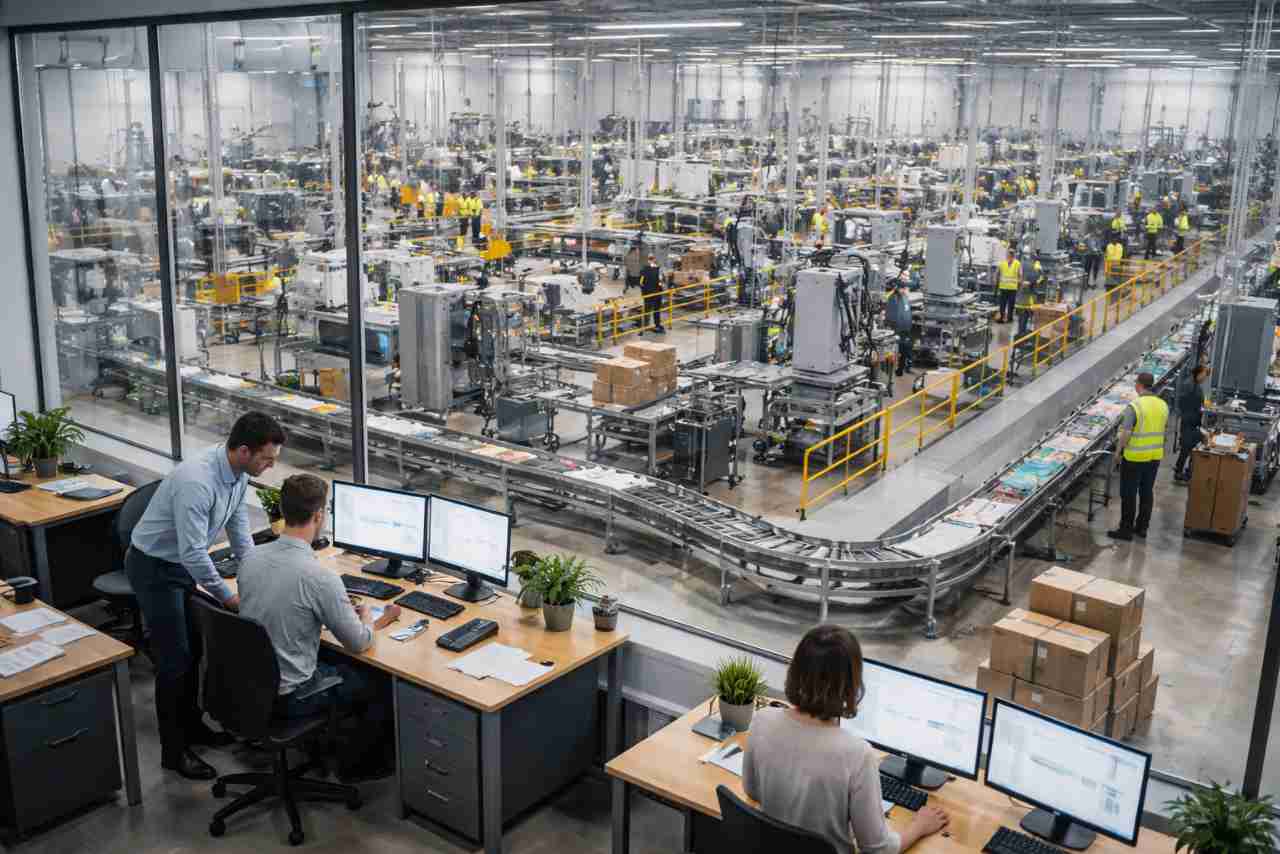
UK manufacturers still rely on spreadsheets, but the inefficiency, data silos and human error they cause are stunting growth. Discover how Microsoft Dynamics 365 and FormusPro help build smarter, connected operations.

Agentic AI Is Already Here… But Are You Ready?

Who’s In Charge Of Teaching Your AI Right From Wrong?
Right across the UK, manufacturers have spent years chasing marginal gains on the factory floor.
Production schedules are tighter, equipment uptime is higher and automation has already delivered most of the easy wins. But despite all that progress, many businesses still struggle to turn improved output into improved profit.
Which is what I’m talking about today. I don’t think the reason is mechanical… it’s operational.
Whilst your production line may be finely tuned, many of the systems I often see behind it aren’t. Finance, supply chain and operations teams still work from different data, making it difficult to see where value is gained, lost or delayed.
That’s why the next leap in manufacturing efficiency will come from integration, not iteration.
By connecting systems like Microsoft Dynamics 365 Business Central, Supply Chain Management and Finance, manufacturers can create a single, connected view of performance, linking every order, supplier, invoice and shipment in real time.
At FormusPro, I help manufacturers do exactly that: bringing finance, operations and data together so you can see clearly, act faster and turn productivity into profit.
Manufacturers have measured success by looking to the shop floor.
Faster throughput, reduced waste, shorter cycle times… all the traditional metrics of efficiency. Yet many are now reaching a point where the machines are running smoothly, the teams are highly skilled, and the gains from further production tweaks are minimal. That means the real opportunity now lies elsewhere.
Behind every efficient production line sit dozens of moving parts, procurement, logistics, invoicing and reporting to name just a few, often handled by different systems that don’t speak the same language.
Production may flow seamlessly, but delays in purchase approvals, mismatched cost data or late supplier updates quietly erode those hard-won gains.
Efficiency, in other words, now depends on coordination as much as capability.
To move beyond the plateau, manufacturers need to connect what’s happening in the factory to what’s happening around it, the finance systems that track profitability, the supply chain tools that manage inventory and the planning platforms that forecast demand.
That’s where FormusPro and the Microsoft tech Stack comes into their own.
Business Central provides the operational heartbeat, managing daily processes across orders, stock, production and delivery. Supply Chain Management adds the visibility and control to synchronise materials, logistics and supplier performance in real time. And D365 Finance closes the loop, aligning every operational decision with financial outcomes… so businesses can see not just how efficiently they produce, but how effectively they grow.
To my mind, that’s where transformation really begins.
I work with manufacturers day in and day, discussing and helping to implement Dynamics 365 architectures that unify production, supply chain and finance data.
The result we aim for aren’t just better reporting though… they’re a shared understanding across departments of where value is created and where it’s lost.
Once that alignment exists, efficiency stops being something measured in output per hour and starts being measured in pounds of margin protected.
Any factory’s mechanical efficiency will eventually hit a ceiling.
You can only make a line run so fast before costs, maintenance or safety intervene. The good news though is that organisational efficiency doesn’t share that limit. By digitising approval flows, automating procurement and integrating production schedules with financial forecasts, manufacturers free skilled staff to focus on continuous improvement rather than constant firefighting.
When processes across finance, operations and supply chain are automated through Microsoft Dynamics 365, productivity gains compound. A single change, for example, a revised delivery date or altered material requirement, ripples instantly through dependent workflows, ensuring every team acts on the same truth.
That’s how companies turn incremental improvements into systemic advantage.
Many firms I speak with are still investing heavily in Lean or Kaizen programmes to squeeze marginal gains from production.
Don’t get me wrong, those efforts remain valuable, but to my mind they often overlook the bigger opportunity: connecting the data that supports them. Without integrated systems, improvement projects stay localised… a line runs faster, but purchasing, finance and logistics are still catching up.
A connected Microsoft Dynamics environment changes that.
Business Central, Supply Chain Management, Finance and more share live operational data, allowing leaders to see the impact of each improvement across cost, cash flow and delivery performance.
With FormusPro’s implementation expertise, manufacturers gain the ability to scale efficiency beyond the production line, turning isolated process wins into sustained, measurable business growth.
Even the most efficient of manufacturers lose time and profit when if finance, supply chain and operations drift out of sync.
On the surface, production targets are being met. Orders are shipped, machines are running, and customers are satisfied. But beneath that success, unseen misalignments, be it costing, procurement timing or cash forecasting, chip away at margins.
For most of the organisations I’ve spoken, these aren’t people problems; they’re system problems.
Their data moves in batches; approvals depend on email trails and reporting happens after the fact.
But it’s always the same end result… a lag between what the factory does and what the business knows.
Great Production, Poor Visibility
When a production line is performing flawlessly; it can be difficult to see why profit is shrinking or lead times are slipping. When supplier deliveries change, purchase prices rise or stock is reallocated, the impact often stays invisible until month-end reports arrive. That’s when teams realise too late that an apparently strong run comes with a hidden a cost. In my experience, it’s disconnected processes that are usually to blame.
Separate ERP, procurement and finance systems create blind spots between departments, forcing teams to reconcile data manually. Every hour spent matching invoices to orders or updating spreadsheets is an hour not spent improving performance.
Microsoft Dynamics 365 Supply Chain Management brings those moving parts together.
It connects demand planning, procurement and logistics so changes ripple instantly across the operation. Combine that with Business Central’s workflow automation and FormusPro’s implementation expertise, and you get a live picture of your entire value chain… materials, labour, transport and cash, all in one solution.
That visibility turns firefighting into forecasting and helps leadership teams see exactly where profit is being won or lost.
Finance departments often find themselves analysing history whilst operations are already making tomorrow’s decisions. Without real-time integration, cost variances, supplier penalties or freight surcharges will often only surface after the books close. By then, the chance to adjust pricing, renegotiate contracts or redirect spend has vanished.
Microsoft Dynamics 365 Finance closes that gap.
By linking directly with Supply Chain Management and Business Central, every transaction, from purchase order to shipment updates financial records automatically. Cash-flow forecasts, margin insights and cost allocations refresh in real time, giving CFOs and operations leaders a shared, accurate picture of performance.
Working with FormusPro, manufacturers build architectures where finance and operations run from the same live dataset. That alignment doesn’t just speed reporting; it changes behaviour.
Teams collaborate on decisions with financial impact in mind, choosing suppliers, planning capacity and scheduling production with full visibility of working capital and profitability.
Efficiency stops being an operational metric and becomes a financial one.
Once finance, supply chain and operations begin working from the same data, decision-making changes fundamentally.
What once required end-of-month reports or cross-department meetings now happens in real time. Teams no longer debate which figures to trust or use, they act on a single version of truth.
That’s the power of a connected Dynamics 365 environment.
Business Central, Supply Chain Management and Finance aren’t isolated systems; they’re parts of a continuous flow of information. Together, they provide end-to-end visibility, from the first sales order through to invoicing, shipment and margin analysis.
For manufacturers, this integration turns disconnected processes into coordinated decisions. Procurement, production, logistics and finance stop working in parallel and start working in rhythm. And with FormusPro’s expertise aligning those solutions around each organisation’s unique processes, insight becomes instant, not retrospective.
Every manufacturing business I’ve ever seen sits between two pressures, operational reality and financial expectation.
Production teams focus on materials, labour and deadlines, whilst finance cares about cost control, cash flow and compliance. Business Central bridges that gap by acting as the operational conductor between the shop floor and the balance sheet.
Through automated workflows and connected data, Business Central keeps purchase orders, work orders and invoices synchronised. When a production schedule changes, finance sees the impact immediately. When a supplier updates pricing, procurement can approve alternatives based on real-time margin visibility.
This orchestration prevents the classic “lag effect” that eats into profit.
Decisions about sourcing, scheduling or pricing no longer depend on outdated reports, they’re driven by live operational and financial data.
And with FormusPro guiding the integration, manufacturers get a single, agile environment where every department pulls in the same direction.
In a connected Dynamics 365 ecosystem, automation becomes more than convenience, it’s the foundation of scalable efficiency. Every manual step between ordering, manufacturing and invoicing introduces delay and risk. Automating those handovers frees staff to focus on value-adding work and ensures accuracy at every stage.
The parts of the Microsoft Tech Stack we’ve been discussing let you automate core processes like purchase-to-pay and order-to-cash, linking every transaction back to real-time financial data.
They not only reduce administrative effort but also gives leaders continuous insight into working capital, supplier performance and customer demand.
When implemented by FormusPro, we make sure automation aligns with real business logic, so approvals reflect internal policy, alerts trigger when thresholds are breached, and dashboards display what matters most to each role.
The result is a smoother, faster route from purchase to profit: every decision supported by data, every action measurable in financial terms.
Once production, supply chain and finance work from the same data, efficiency stops being a measure of output and becomes a measure of value.
Many manufacturers still focus on throughput… how much product leaves the factory each week etc., but that tells only half the story. The real test is how quickly that activity turns into revenue, how smoothly cash flows, and how confidently leadership can reinvest.
Modern efficiency shouldn’t just be about running faster; it should be about running smarter.
When operational and financial systems get joined up, every decision, from purchasing to production planning, carries an instant financial consequence. That’s what makes integration so powerful: it converts effort into measurable economic impact.
We all know a production line can be busy but still be unprofitable.
That tends to be because of hidden costs, such as unplanned overtime, material surcharges or freight premiums, often erode margins long before invoices reach customers. Without connected finance data, those inefficiencies remain buried in monthly summaries.
D365 Finance exposes the real-time relationship between activity and outcome. It tracks cost drivers across every process, mapping where resources are consumed and how they convert into value. When integrated with Business Central and Supply Chain Management, it reveals which products, suppliers or workflows deliver the strongest return.
With that insight, manufacturers can prioritise high-margin work, refine procurement strategies, and price accurately, not reactively.
Efficiency becomes a profit lever, not a production metric.
Cash flow is the quiet force behind every efficient operation.
Delays in invoicing, long supplier terms or inaccurate demand forecasts can tie up working capital and slow growth. Yet with live integration across Dynamics 365, cash visibility improves automatically.
Business Central and Finance synchronise receivables, payables and inventory valuations in real time. That means financial leaders can model scenarios, adjust credit strategies and plan investments with full awareness of operational impact.
When implemented with FormusPro, that visibility becomes strategic. Manufacturers can anticipate shortfalls before they happen, align production schedules with liquidity, and negotiate confidently with suppliers. Cash stops being a constraint and becomes a source of agility… funding innovation, expansion and resilience even in volatile markets.
The story of manufacturing efficiency has shifted.
The biggest wins no longer come from squeezing a few extra units off the line, but from connecting every decision that makes those units possible. When finance, supply chain and operations finally speak the same language, clarity replaces chaos… and profitability follows.
And it’s Microsoft Dynamics 365 that makes that connection possible.
Business Central keeps daily operations moving smoothly, Supply Chain Management synchronises demand and delivery, and Finance translates every action into real-time economic impact. Together, they create a single version of truth that powers faster decisions, sharper forecasting and stronger margins.
At FormusPro, we help manufacturers turn that potential into performance. Our consultants design, deploy and refine connected D365 solutions that make finance and operations one continuous system… adaptable, resilient and ready for what’s next.
If your production line is already running efficiently (or even if it’s not), it’s time to look beyond the factory floor.
Talk to me about connecting your finance, supply chain and operations with Microsoft Dynamics 365, and discover where your next efficiency gains will really come from.

Written By:

Microsoft Copilot vs ChatGPT… Which AI Should You Be Using?

Why Digital Natives Are Struggling For The Digital Skills They Need
Ready For More?