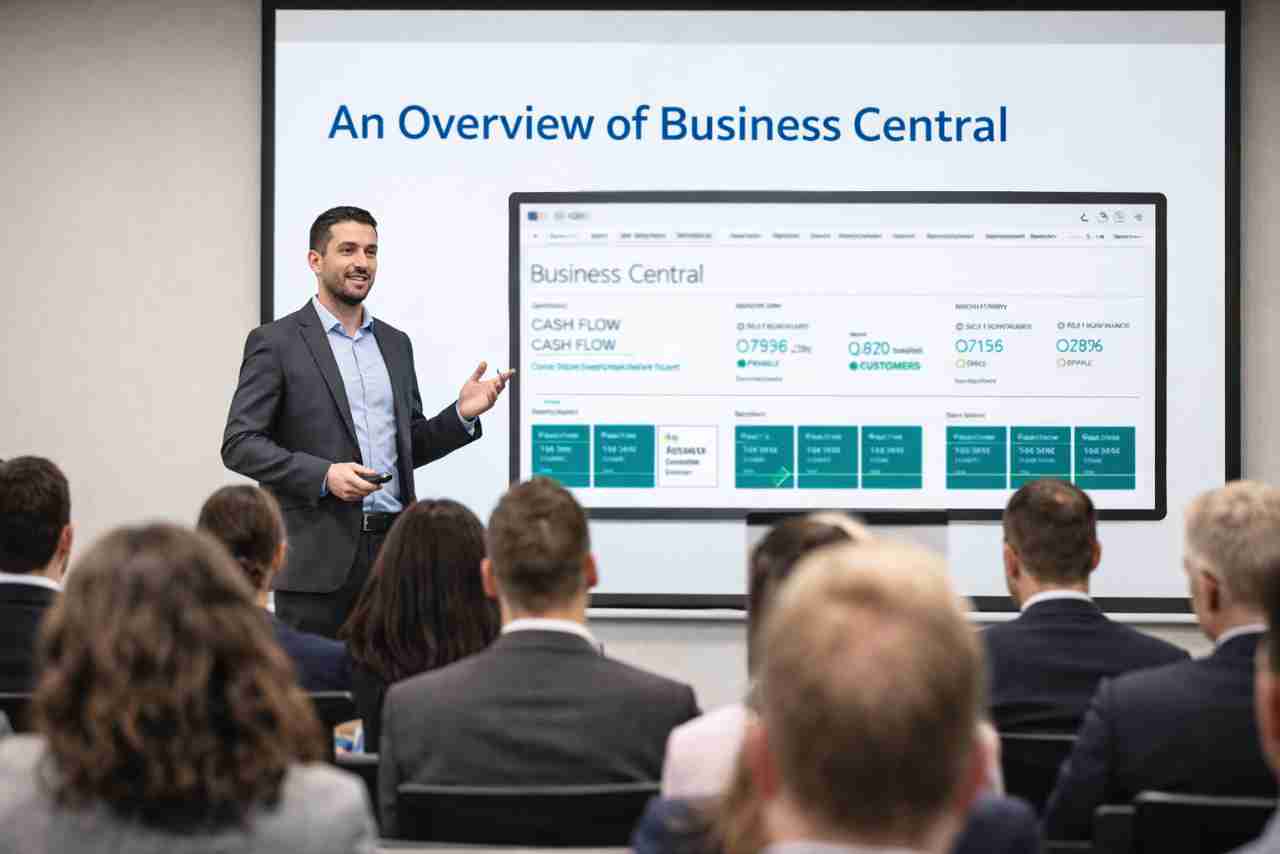
A Quick Overview Of Dynamics 365 Business Central’s Main Features and Benefits

The Key Features Your New ERP System Really Should Have
We all know Nonprofits are under constant pressure to do more with less. I’ve yet to meet a fund-raising team that doesn’t run lean. And the hard truth is that there’s a lot of people that need help, and only so many donations that can be given.
That makes fundraising a constant pressure.
But charities are also under constant scrutiny in other areas too, like governance and reporting… and we all know how much harder it’s become to engage donors, volunteers and even staff.
Which is why, I think, FormusPro is seeing such an increase in enquiries about where AI Agents can relieve some of the pressure from NfPs shoulders.
But let’s be clear… an AI agent isn’t just another automation tool.
It’s a system with a sophisticated semantic layer that can actually interpret your objectives, decide what needs to happen next and take actions across your tools, all within guardrails defined by you.
AI Agents increase efficiency and remove human errors from repeatable, manual work that consumes time every week.
For NonProfits already using platforms like Microsoft Dynamics 365 or the Microsoft Power Platform, the foundations to build practical AI agents may already be in place.
So the question isn’t whether the technology exists. It’s where it can have immediate effect for you.
The phrase “AI agent” tends to sound a lot more technical than it actually is.
At its core, an agent is just a piece of software that works towards a goal rather than waiting for a specific instruction. You define the objective, the systems it can access and the boundaries it operates within. The agent then decides what steps are needed to move things forward.
That might mean monitoring activity, reviewing new data, triggering actions or escalating something to a human when it falls outside its rules.
That means the key difference between an AI Agent and traditional automation is flexibility.
Automation follows a script, but an agent evaluates context.
So instead of a workflow that says, “If X happens, do Y”, an agent can look at a situation, decide which actions make sense and carry them out across multiple systems.
For a NonProfit, that could mean checking donor engagement, drafting a follow-up message, updating records in your CRM or flagging high-value supporters for personal outreach. All without someone manually coordinating each step.
None of this means the system runs unchecked.
As I say, Agents operate within guardrails that you define. Permissions, escalation points and audit trails all still apply.
Think of it less like replacing people and more like giving your organisation a set of digital colleagues that can handle the repetitive coordination work.
Once you understand that idea, the next question becomes much more practical.
How do you actually build one?
The idea of building an AI agent might sound like something that requires a team of data scientists and months of development. But Microsoft have made it so that just isn’t true anymore.
Modern platforms make it possible to design agents using tools that connect to the systems you already use. For many NonProfits, that means building agents on top of platforms like Microsoft Dynamics 365 and the Power Platform.
One of the tools gaining the most attention in this space is Microsoft Copilot Studio. It allows organisations to design AI agents that interact with their data, trigger actions and work across different systems without starting from scratch.
At a high level, the process usually looks something like this.
First, define the objective. What problem should the agent solve? That could be identifying donors who are at risk of lapsing, tracking grant deadlines or helping coordinate volunteer scheduling.
Next, connect the systems and data the agent needs access to. That might include your CRM, email, document libraries, finance tools or knowledge bases.
Then set the guardrails.
Decide what the agent is allowed to do on its own, where it needs approval and when it should escalate something to a human.
Finally, test and refine. Like any new process, the first version rarely stays the final version. Agents improve as you see how they behave in real situations and adjust the boundaries around them.
None of this will require replacing your existing systems.
In most cases, agents sit on top of the platform’s NonProfits are already using and help coordinate the work happening between them.
Which leads to the interesting part.
Once you understand how agents are built, it becomes much easier to imagine where they could start making a difference.
Once you start thinking about agents in practical terms, opportunities appear surprisingly quickly.
Most charities already run dozens of small processes that involve checking activity, reviewing information and coordinating actions across different systems.
None of that work is particularly complex, but it does take time. And when teams are small, that time adds up.
Just think about how often someone has to:
Individually, each task is small.
Together, they create a steady background load that pulls staff away from higher-value work.
That’s exactly the type of work AI agents handle well.
With that in mind, here are nine practical AI agent use cases NonProfits could begin exploring today.
One of the most common challenges in fundraising isn’t attracting new donors. It’s keeping existing supporters engaged.
Most NonProfits already track donation patterns inside their CRM, but recognising when someone’s drifting away often depends on someone noticing the signals in time. That can be difficult when fundraising teams are small and supporter lists are large.
An AI agent could monitor donor engagement automatically. It will review giving history, email engagement and event attendance, then flag supporters who appear to be disengaging.
From there, the agent could draft a personalised follow-up message, create a task for a fundraiser or suggest an appropriate next step based on the donor’s past activity.
Instead of discovering lapsing donors months later, your team gets early signals and a suggested response whilst the relationship can still be strengthened.
Grant funding can be transformational for NonProfits.
It can also be incredibly difficult to track. New opportunities appear regularly. Eligibility requirements change. Deadlines approach faster than expected. And in many organisations the responsibility for monitoring those opportunities sits with someone who already has a full workload.
But an AI agent could easily monitor grant databases, internal documents and application pipelines. It could flag opportunities that match the organisation’s focus areas, track submission deadlines and alert staff when preparation work should begin.
Once an application is in progress, the same agent could monitor progress, remind contributors about missing inputs and keep the submission timeline visible.
Instead of relying on spreadsheets and manual reminders, your organisation gains a system that keeps opportunities visible and helps ensure nothing slips through the cracks.
Volunteers keep the vast majority of NonProfits running.
Finding them, preparing them and coordinating their time however can quickly become a job in its own right.
Recruitment alone involves multiple steps. Applications need reviewing. Availability needs checking. Suitable roles need matching. Then comes onboarding, which often includes sending welcome materials, gathering information, arranging training and making sure safeguarding requirements are met.
An AI agent will manage that entire journey.
It could review new volunteer enquiries, categorise them based on skills or interests and suggest suitable opportunities. When someone signs up, the same agent could trigger the onboarding process automatically. Welcome emails are sent. Documents are shared. Training sessions are suggested. Required forms are collected and stored in the right place.
Once volunteers are active, the agent could then monitor availability, match people to upcoming events and flag gaps before they become a problem.
Staff still oversee the programme and build relationships with volunteers but the difference is that much of the administrative coordination happens in the background rather than filling someone’s inbox.
Membership organisations often rely on predictable renewals to maintain financial stability. The challenge is that renewal campaigns can become repetitive and easy for members to ignore.
Most organisations send reminders as the renewal date approaches but if the message doesn’t land at the right moment, the opportunity can be missed.
An AI agent can take a more responsive approach.
By reviewing engagement patterns, event attendance and communication history, the agent can identify members who may need a different type of outreach. Some might receive a reminder tied to a recent event. Others could be sent an update about new programmes or achievements they helped support.
The agent can monitor responses as they happen, update records and flag members who may benefit from personal contact.
It won’t replace relationship-building, but it does help the right conversations start at the right time.
Anyone who’s organised a fundraising event knows how many moving parts sit behind the scenes.
Guest invitations, volunteer coordination, venue logistics, donor engagement and follow-up communications all have to line up. Even a small event can involve dozens of small tasks scattered across email threads and spreadsheets.
Fortunately… you can now build an agent for that!
It might monitor RSVP responses and update supporter records automatically. Key attendees can be highlighted so the team knows who to prioritise. Volunteers receive reminders about their roles and timings.
As the event concludes, the agent could trigger thank-you messages and prompt follow-up conversations with potential donors.
Lots of NonProfits deliver services directly to people who need support. That means requests for help will arrive through multiple channels… but the urgency of those requests isn’t always obvious at first glance.
An AI agent could help sort through that incoming flow.
Messages and enquiries can be reviewed as they arrive, then categorised according to the type of support required. Straightforward requests might be directed to the right programme automatically. Situations that appear more urgent can be escalated immediately.
In some cases, the agent could also provide initial guidance based on approved information or knowledge resources.
Gift Aid is one of the simplest ways UK charities can increase the value of donations.
At the same time, the rules around eligibility and record keeping can create administrative pressure.
Declarations must be complete. Donor details need to be accurate. Records have to be ready for review if HMRC ever asks questions.
An AI agent could monitor those records continuously rather than leaving checks until claim time.
If a declaration is missing, the agent can prompt the donor. If information looks inconsistent, the issue can be flagged early. When it comes time to prepare a Gift Aid submission, the underlying data is already cleaner and easier to work with.
Finance teams spend less time chasing paperwork and more time focusing on the bigger picture.
Impact reporting is essential for demonstrating the value of any NonProfit’s work. It’s also one of the most time-consuming administrative tasks many teams face.
Information lives in multiple places. Programme statistics, financial summaries and service outcomes all need to be manually gathered (chased) and turned into something trustees or funders can quickly understand.
An AI agent can help assemble that picture though.
By pulling together data from programme records, CRM systems and reporting tools, the agent can produce a structured summary of activity over a given period. Early drafts of board updates or funder reports can be prepared automatically.
Restricted funding brings both opportunity and responsibility. Donations and grants often need to be used for specific purposes, and organisations must be able to demonstrate that those funds have been handled correctly.
Tracking this across programmes can be complicated, particularly when spending is happening in different departments or systems.
An AI agent can monitor those financial movements as they happen.
It can review transactions against the rules attached to each fund, highlight potential issues and alert finance teams when spending approaches a predefined threshold. Regular summaries can also be prepared for leadership teams so they have a clear view of how funds are being used.
Instead of discovering problems during a quarterly review, your organisation gains visibility as activity unfolds.
If there’s one takeaway from all of this, it’s that AI agents aren’t a distant idea reserved for large tech organisations. The tools already exist, and for many NonProfits the foundations are already sitting inside the systems you use every day.
All that’s needed now is to locate the right starting point.
Not every process needs an agent.
But the NonProfits I speak to all have areas where people spend hours coordinating information, checking activity or moving data between systems. Those are often the places where an AI agent can make an immediate difference.
And the people who are doing this well are the ones who tend to start small.
One process. One objective. One carefully designed agent operating within clear boundaries.
From there, the lessons learned can be applied to other areas of the organisation.
Over time, that approach builds something powerful.
Not a sudden “AI transformation”, but a series of practical improvements that give teams more time to focus on fundraising, service delivery and impact.
If you’re exploring where AI agents could fit within your NonProfit, this is exactly the type of work we help organisations with at FormusPro.
From identifying suitable use cases to designing and building agents using platforms like Microsoft Dynamics 365, the Power Platform and Copilot Studio, our team works with charities to make sure these technologies are implemented in a practical and responsible way.
If you’d like to explore what AI agents could look like inside your organisation, get in touch with FormusPro and start the conversation.

Written By:

Help Me Understand AI, AI Agents, Copilot, Automation & Full Autonomy

Why The Best Consultancies Don’t Just Say Yes
Ready For More?